Saturday, February 15, 2025

Condoms to the Taliban! (Or Was It Hamas?)

Once again, I am in receipt of a communications from my not-so-esteemed Congressional Reprsentative, Robert Aderholt of the 4th district of Alabama.

Actualy, Representative Aderholt was responding to a phone call from my wife.  She was expressing concerns of some of the Department of Government Efficiency (DOGE) actions. One of her concerns was the cancellations of funds going to the United States Agency for International Development (USAID) and foreign aid through the State Department.

The respresentative's letter to her listed a litany of MAGA/DOGE talking points.  No surprise there.

It was the conclusion about USAID that caused me to pay particular attention.

Representative Aderholt cited a statement by Representative Brian Mast, Chair of the House Foreign Affairs Committee, which concerned waste, fraud, and abuse by the agency.  The list included:

  • $15 million for condoms for the Taliban through USAID.  (The White Huse Press Secretary had it for Hamas, but details don't matter do they?)
Now let's think critically about that for a minute.  Is it likely that the oh-so-forward-thinking Taliban are even interested in family planning, especially family planning where the male has responsibility?  That leftist pinko publication Forbes refuted this and other silly claims in Forbes.  There have been disbursements to the International Medical Corps that provides aid to victims of war, totaling more than $100 million, in which “family planning programming,” including contraceptives, were included, which is typical for aid packages to developing countries, the Associated Press reported.  In the last three years, there have been no disbursements for condoms to any countries in the Middle East.

(Man, this fact checking can be exhausting!)

Other equally suspect items on the list:
  • $1 million to boost French LGBTQ in west and central Africa through the State Department.
  • $20,600 for a drag show in Ecuador through the State Department.
  • $446,700 to promote the expansion of atheism in Nepal through the State Department.
From Newsweek:  The source for his claim is likely the U.S. government proposal from April 2021, which offered funding to help overseas groups "combat discrimination, harassment and abuses against atheist, humanist, non-practicing and non-affiliated individuals of all religious communities."
Read in detail, the proposal from the U.S. Department of State, Bureau of Democracy, Human Rights and Labor (DRL) is an offer to fund these groups so they may practice their views with safety and support—much like American citizens do under the guarantees of the U.S. Constitution.
The money, to be used over an 18 to 30 month period, was made available to groups and organizations in South/Central Asia and Middle East/North Africa (excluding Libya, Syria, and Yemen) only.

Not exactly the same as "promoting" atheism, is it?  It's more like we're promoting the spirit of the establishment clause of the First Amendment.

The point I guess is we have a department of the government, Treasury, making misleading statements to Congress and Congress (two of the representatives) simply repeating those statements.  Joseph Goebbels couldn't do it any better.

Oh, and Representative Aderholt proudly tells us that he has joined the DOGE caucus.  It's all very cringe worthy.


Thursday, February 13, 2025

Note to Senator Katie Britt February 14, 2025

 February 14, 2025


Senator Katie Britt

660 Gallatin Street Southwest

Suite 1400

Huntsville, AL 35801


Dear Senator Britt,


I write to you to express my dismay at your support of President Trump’s executive actions.  Here are two examples.


1. First, thank you for your response to my earlier email. I found that the content of that response to be dismally lacking in fact, parroting the “declarations” by President Trump of wholesale waste, fraud, and inefficiency in the various agencies of our federal government and referring to “foreign entities and radical leftwing causes.”  No one in the administration or DOGE is bothering to cite specific examples of these deficiencies. Forgive me, but my experience with the first Trump presidency makes it difficult for me to accept these declarations as true.

2. I see where you have introduced legislation attempting to codify the removal of birthright citizenship as guaranteed in the Fourteenth Amendment to the Constitution. Refer to an episode of Throughline, NPR's history podcast on birthright citizenship. After much thought, I believe revoking that clause implies none of us are citizens. Going back to our earliest ancestors to come to America, their children would not have been citizens. Nor would their children, and theirs, and so on until the present generation. 


I could go on, but you get the idea. In my opinion and with apologies to our Latin American neighbors, President Trump is acting more like a banana republic “El Presidente.”  He lies and his minions, including Elon Musk, repeat those lies. 


Please do your job. Exercise some oversight into the Executive Branch and please, please find a spine.


Jim Coleman

2099 Hickory Trail NE

Arab AL 35016

256.640.0405

jcole724@gmail.com


Friday, February 7, 2025

What's Goin' On

 With apologies to Marvin Gay.

What's goin' on:

  • The president has broken our country's promises and moral obligation to people from Afghanistan by turning his back on them.
  • During the campaign, he promised that he knew nothing about Project 2025.  Yet, his executive orders are carbon copies of the Project's playbook.
  • Multiple administrations from both parties have long supported USAID.  Its efforts served as "soft diplomacy" to encourage friendly relations with many countries in the world whose people were on the margins.  But now it's gone.
  • I pity my children and grandchildren who will suffer the effects or the president's cancellation of funding for renewable energy projects and general rejection of climate change as a reality.  I see irony in his continued denial of climate change but insisting that climate change has changed the shipping lanes so that Greenland suddenly becomes an object of his avarice.
  • What he has done to the immigration system is morally reprehensible.  Why do people want to come to the United States?  They see it as a land of opportunity and hope, when they live in hopelessness.  
  • Why does he lie so much?  And his administration doubles down on the lying.  I don't know how his new press secretary can look herself in the mirror in the morning.
  • Then there's the whole Elon Musk business.  If that's not frightening, I don't know what is.  Allowing unvetted persons to have access to some of our country's and its people's sensitive data borders on treason (and maybe more than borders on).
  • Now he's rambling about turning over the air traffic control system to Musk's Starlink network.  What's the worst that can happen?
  • Now he's charged his new Attorney General with wiping out "anti-Christian bias" from the government.  Really?  Where are Christians under attack?  Christians are the least discriminated against sector of the population.  We're not a Christian country, but that hasn't stopped us from building churches on every other street corner!
  • He's questioning funding for the United Nations.  Really?  How many of us remember trick or treating for UNICEF?  His attitude oward international bodies like the UN, the International Criminal Court and the World Health Organization is very suspicious.  There's isolationism but this is ridiculous.
  • While we're on morally reprehensible topics, there's Gaza.  He actually thinks he can simply declare that he's going to relocate people from their homeland and build a fabulous resort after clearing away the ruins of the Gaza war.  "It's going to be beautiful!"  Maybe that's why he gets nervous when the International Criminal Court is mentioned.
  • He's signed an executive order instructing his successor to obliterate Iran if Iran is reponsible for his assassination.  He thinks he can control things from the grave.
  • Where did this idea about Canada becoming our fifty-first state?  How insane is that?
  • He thinks the United States should take back the Panama Canal.  Ludicrous!
  • He falsely, of course, claimed that the US sent fifty million dollars in condoms to Hamas.  That makes me think someone has a worm in his brain.
I could go on but I'm sure there will be more to add to the list.

Never, and I mean never, have we had such a deranged President fostering so much corruption in our government.

Saturday, February 1, 2025

Some Thoughts on a Different Kind of Evolution

It appears to me that we Christians have had it all wrong for some period of time.

Let's talk about God, first and foremost.

The Hebrew Bible (Old Testament) starts us off with two stories of creation.  God speaks all  things into existence.

It's time for us to grow up and recognize the Bible for what it is and isn't.

Implicit in Genesis is a common acceptance that some things are wrong:
  1. Murder -- Cain and Abel.
  2. Deceit -- Jacob "stealing" his birthright.
  3. Theft -- see #2.
  4. More deceipt -- Joseph's brothers and their treatment of him.  Selling a brother into slavery.  Envy.  Lying to Jacob about what happened.
On the flip side, some things are "right":
  1. Mercy -- God does not exact retribution on Cain.
  2. Forgiveness -- the reconciliation of the two brothers Esau and Jacob and the reception Joseph gives his brothers in Egypt.
As we move into Exodus, Leviticus, Deuteronomy, and Numbers, the law is laid out.  First the ten commandments, broken into two sections:  how the people treat God and the people should treat each other.  These are followed by the six hundred elements of the laws of the Hebrew Testament.

What is their intent?  I believe they were primarily meant to help people live together.  Seems obvious, doesn't it?  Don't murder each other, don't lie, don't want what your neighbor has, don't steal, don't take your neighbor's spouse.  In hindsight, it is obvious; in fact, it's the basic bedrock of any society, large or small.

Now, let's take a brief detour from the Bible and into science.  Darwin's theory of evolution is a theory, it can't be proven.  But you would be hard pressed to cite instances of where it has been disproven.  So, let's assume it describes the way life came to be on planet earth.

From one-celled creatures in the swirling waters of the seas to fish to reptiles that crawled upon the land, then birds, dinosaurs (they are gone, thank goodness), mammals, primates.  At some point, one of these creatures became aware of its own existence.  It congregated into communities of similar beings.  Eventually, one of these self-aware creatures realized, for the tribe/family/community to survive, there needed to be some rules for living together.  The earliest of these rules were no doubt passed around verbally or orally, writing not having been invented.  Later, in the cradle of civilization in what we now call the Mideast, laws were written down.  Several have been discovered, the oldest and best known being the Code of Hammurabi.  

Later, the Hebrews came along and committed to writing the stories of their history and the laws that had been formulated.  If you declare that they came from God, they have a certain amount of weight!

Now the other idea that early humankind shared is a need to explain how everything came to be.  And, to make a very long story short, that explanation is given a name:  in English, God; in Arabic, Allah; in Hebrew Yahweh or Jehovah; in Hindu India, the gods have many names and many purposes.

So, you can believe that some being created everything including the rules to live by or you can believe that the rules came about naturally, as a means for community survival.


Saturday, April 29, 2023

Blessed Sacrament School

Gentle daughters,

(I started writing this three years ago but left it and forgot about it.)  

I turn to telling you what it was like to grow up Catholic, attending a parochial school in the fifties and early sixties.  It was very different from your experience at an Episcopal school for girls in the eighties, nineties, and aughts of the twenty-first century.

First Grade

In the fall of 1955, I entered first grade (there was no kindergarten available at the time).  I had just turned six years of age.  I remember the first time we gathered outside the little (and old) building that housed the first grade, second grade, and the school cafeteria.  Because the school had limited space (remember, this was during the famous post-war baby boom), there were five classrooms on the second story of the parish church building.  Another building on the "church block" housed the sixth grade.  This is a picture of the church today.  The exterior hasn't changed much in sixty years.

My first grade teacher was Sister Mary Gemma, S.M. (Sisters of Mercy).  The Sisters of Mercy were an order of nuns, founded by an Irish Catholic woman.  The nuns who taught at the school lived in a convent building across the street from the little first/second grade building.  At the time they wore a "habit", kind of a nun uniform.  This is a picture of nuns wearing the habit.  They never showed their hair and wore a large rosary around their waist.  There were about five who lived in the convent and taught at the school, including the principal.

As intimidating as the habit made them appear, Sister Gemma was a wonderful teacher.  She taught me arithmetic, reading, spelling, and religion.  The lay teacher in the second grade next door, Mrs. Lowery, would teach us phonics while Sister Gemma taught the second grade religion.

I think it's important to pause here and explain about phonics.  I'm sure a later version of phonics was taught in your school, but the subject matter involves the sounds letters make in the English language.  Although English can be a quirky language phonetically (e.g., though, tough, thought), you can get by pretty well the majority of the time by knowing the sounds the letters represent in the language.  I believe phonics is the reason I became skilled at spelling and reading, in fact developing a lifelong love of reading.

I didn't attend kindergarten (our school didn't have one) so one of the first things Sister Gemma had to teach was the alphabet.

The interplay of phonics, spelling, and reading provided a tremendous foundation for later learning.  I think your grandmother, Mildred Stevens, would have had a lot in common with Sister Gemma and Mrs. Lowery.

Religion and arithmetic were taught by rote, memorizing the Baltimore Catechism and number facts.

The Baltimore Catechism was developed by the Catholic Church during the nineteenth and early twentieth centuries as a means of helping Catholic students learn about their church and their beliefs.  I think it was likely motivated by the influx of Irish and Italian Catholic immigrants and the children who were their offspring.

The Book of Common Prayer of your Episcopal upbringing has a Catechism.

At the age of six, first graders were not ready for more complex questions and answers, so the question-response nature of the catechism was watered down.  "Thou shalt not bear false witness" translated to "You shall not lie".  "Thou shalt not kill" became "You shall not become angry."  "Thou shalt not covet they neighbor's wife " transformed to "You shall not have impure thoughts."  (Although, frankly, I can't imagine what impure thoughts a six-year-old could have.)  This will give you a hint as to what it was like.

Arithmetic was basically memorizing many number facts.  Having not attended kindergarten, arithmetic first meant learning how to count.  Then we had to memorize "addition tables" (one plus one equals two).  The relationships between numbers was not, to my recollection, a part of this early training.  We learned which numbers were odd and which were even.  Once we learned how to add, constant drill occupied our class hours and homework.

Our day started, every day, with 8 am Mass.  The entire school was expected to be in the pews at 8:00.  Mass usually ended around 8:30 when we were marched to our classrooms.  Mass in those days was conducted entirely in Latin, without homily or sermon, the priest at the altar with his back to the congregation.  We first graders were not permitted to receive communion (more on that later).  In fact a stern rule of silence was in place. Apparently, I must have broken that rule once.

One day, Sister Gemma called me to the front of the classroom where she waited with my friend Russell Caccamisi.  Sister looked at me and asked, "Were you and Russell talking during Mass?  He says you were."  Flustered, I frankly couldn't remember whether I had been talking or not.  Of course, I confessed and received a punishment to write from 1 to 200.  (I don't know what she was thinking.  I didn't know what 200 was.  So, I wrote from 1 to 102 and gave it to her and she asked that I do it again.)  Later in my school days, a similar event took place with more dire consequences.

I promise I'm not bragging when I tell you that I was really smart compared to most of my peers in elementary school.  For a while, there was always one girl who equaled or exceeded my grades and other accomplishments in school.  One was a girl named Linda Pounders.  After the first grade she was permitted to skip second and enter the third grade.  I was jealous when that happened.  We were always the last two standing in spelling bees.  We both were selected for a special day at CBC where we were introduced to a different way of teaching arithmetic, a method where you saw the relationships among the numbers.  We were both in the top reading group, the Redbirds if I recall correctly.

You would not have been comfortable with class sizes.  My class ranged from twenty-five to thirty students in a class supervised by one teacher at a time with no aides.  This held true from first through the eighth grades.  The more accomplished students sometimes were enlisted to help.  For example, Sister Gemma might ask me to hear other students recite their alphabet or their numbers.  I do have a distinct memory of being assigned to listen to two or three classmates recite a set of numbers.  At the end, Sister asked me how they did and I said, "Alright, I guess."  (I had become bored listening to them and lost track of their accuracy.)  I think she stopped asking for my help about then.

I had a few friends who went all the way through high school with:  Walter "Bubba" Marshall (who also graduated from college with me), Terry Ryan, and Sean Gillespie.

Second Grade

After an endless summer, we returned to the same little separate school building where we spent our first year, this time with Mrs. Lowery as our teacher.  Because she was our primary teacher, we of course continued learning phonics, reading, arithmetic, and spelling.  I'd lost my academic nemesis, Linda Pounders, to the third grade.  However, she was replaced by an equally imposing challenger, Terry Reedy, another blond girl.  Neither one, I assure you, contributed to any of the "blond jokes" that were being told a generation ago.

I suppose the highlight of this year was preparation for our First Holy Communion.  In the Catholic Church, this is a big deal.  Although we continued our memorization of all of the Catechism's answers, after the break for Christmas, our attention swung to the big dual event in the spring, First Confession and First Communion.

First, Sister Gemma (still switching a religion period in Mrs. Lowery's class with a phonics period in her first grade classroom) had to teach us to make our first confession.  In the Catholic Church, it was a requirement to confess your sins to a priest regularly.

I guess I should explain the Catholic notion of sin first.  In that theology, there are two kinds of sin:  venial and mortal.  A venial sin is a minor sin:  the little white lie, eating all the cookies in the cookie jar, disobeying parents.  A mortal sin is a major sin:  murder, rape, adultery, robbing a bank, missing church on Sunday (more on that at a later time).

The picture painted for us went like this.  Think of your soul as a white canvas.   Venial sins spot the canvas.  Mortal sins paint the whole thing black.

If you have a mortal sin on your soul, you cannot receive Holy Communion.  You must confess the sin to a priest who grants you absolution after you've done a penitential act (a penance).  You may receive communion with mere venial sins on your soul, but it's not advised.

The sacrament of penance, also known as confession, was taught in this way.  The priest sat in a three piece box known as a confessional.  He sat in the middle section.  Penitents knelt on either side.  There was a curtain providing a certain amount of privacy for the penitent.

For your first confession, you entered the confessional and knelt.  There was a small sliding window between the priest and the penitent.  When the priest slid the window open, you said, "Bless me, Father, for I have sinned.  This is my first confession and these are my sins."  At that point, you told the priest all of the sins that were on your soul and how many times you had committed them.  The priest gave you a penance (e.g., say three Our Fathers and three Hail Marys).  You then recited the act of contrition, a prayer you had committed to memory, "Oh my God.  I am heartily sorry for having offended Thee..."  Then you left the confessional with you canvas all clean again, provided you "did" the penance.

In subsequent visits, you told the priest how long it had been since your last confession.

We made our First Confessions on the Friday before the Sunday when we made our First Communions, striving to keep our souls pure on Saturday.

At that time, the rule was that you must have fasted for three hours before receiving communion.  So no breakfast, no orange juice, no anything.  Your body must be as free of food as your soul was free of sin.

On Sunday, we gathered for a special Mass.  The boys were dressed in white suits with white shirts and white ties.  The girls were dressed in white dresses.  We processed into the church slowly and reverently to begin the service.  We had a special reserved section of the church for us.  In place of a sermon, the pastor quizzed us on the Baltimore Catechism.  Of course, I answered perfectly.

I have a picture of my first communion class.  See if you can pick me out.  


At the time for communion, we processed to the communion rail where we knelt and received our first wafer.  We did not receive wine back then.  That was true for adults as well as children.

All of that may sound infantile to you, but to us seven-year olds, it was "gospel."


Wednesday, January 13, 2021

Impeachment #2

 I've been watching the activities in the House of Representatives today.  

I must say that I find both sides lacking in oratorical skills. 

I'm disturbed that both sides use terms like "holy" and "sacred" when talking about the Capitol building.

That implies a degree of divine benediction over the seat of our government.  And that is dangerous.  It ultimately leads to statements like "God is on our side" or "God has blessed America" as though the deity would only favor our country over any other.

But I'm particularly disturbed by the repeated tactics of the Republican speakers.  They clearly were speaking from a script.  They invoked "whataboutism".  Over and over they referred to the Black Lives Matter protests, contrasting the reactions of Democrats to the rioting and looting in those events to their reaction to the action that took place in the Capitol last week.

To me, this is a classic case of false equivalency.  Some of the BLM protests did spawn some more violent actions:  rioting, vandalism, looting.  To that extent, the attack on the Capitol and the BLM protests were similar.

They differ in one fundamental aspect, however.  The BLM protests were happening (and still are happening) in response to a truth:  a systemic abuse of power by police departments across the country.  The abuse resulted in the deaths of black individuals at the hands of white police personnel.  Rarely have the police been held accountable.

The protest at the Capitol was motivated by a lie:  that there had been widespread voter fraud in the November 3 election, enough to steal the election from President Trump.

Comparing the two sets of events is, therefore, specious.  Our representatives should know better, but they've learned from a master at sleight of hand.

Perhaps Godwin's Law may have to replace "what about Hitler" with "what about BLM protests" as the ultimate effort in a losing debate.


Tuesday, November 3, 2020

How the Electoral College Robs Many of Us of Our Vote

 I hate the electoral college.

I vote blue in the reddest of all red states, Alabama.

So, when I vote, it's an exercise in futility.  My vote is not going to get anyone elected.  My neighbor's vote will get someone elected.  

Another feature of the electoral college is that thing the pundits call "swing states".  You know, those half a dozen states that candidates at the top of the ticket spend most of their campaign dollars and time in.

Neither a Democrat nor a Republican, once the primary season is over, is going to bother with us.  The Republicans know the state (and its electors) are in the bag.  The Democrat knows the same thing.

Similarly, no one bothers to campaign in Mississippi, Tennessee, Louisiana, Arkansas, Kansas, Nebraska, California...we all know what states get the attention:  Wisconsin, Pennsylvania, Ohio, Michigan, and Florida.  This year, apparently Arizona inexplicably is up for grabs.

So for most of us, our states receive scant attention from those at the top of the ballot.  Our states receive very little of the considerable cash infusions the swing states get.  The cynical way both sides approach the election is unworthy of our highest ideals.

It's enough to make me embarrassed.  Having read some of the background behind the creation of the electoral college, I know it was based on the agrarian economy of the late eighteenth century and the slavery that enabled much of that economy.  It was an attempt on the part of the slave states to guarantee they would have a bigger voice than their population warranted.  

We no longer have an agrarian economy.  We no longer have slavery.  Why do we have this vestige of both?

To be sure, states with lower population density want to maintain the college.  It continues to give them a voice, in fact, more of a voice than states with higher population density.  This results in a rural versus urban standoff.  There is little or no doubt that the modern Republican party benefits from the college.  It's just math.

Surely, my Republican neighbor in California would like for his vote to count just as much as my Republican neighbor here in Alabama.  

Because the college is established by the Constitution (for an explanation of the rationale behind the college follow this link), it can only be changed through the amendment process.  

Of course, this has been a hot button for Democrats, especially since the 2000 and 2016 elections when the Democrat who won the popular vote failed to win in the electoral college.

I believe it should be an equally hot button for both Democrats and Republicans in states that are not swing states (i.e., most of them).

What do you think?

Wednesday, March 18, 2020

In response

Wow, guys, you've given me a lot to chew on.  I'm sorry it's taking me until today to respond, but there have been other things to attend to (like how my mother is going to survive this pandemic).  Forgive me for using my blog as a medium.  I will only be sharing it with you.  It's format makes it easier for me to respond to the many questions you've posed for me, so here goes:

I'm going to make an assumption about what kind of government is a Bernie/AOC type of government.  I'll assume you think it means it has more elements of "socialism" than you are comfortable with.  I describe myself as a Matthew 25 Christian of the Episcopal persuasion.  That means we are called to care for the "least of these."  For Jesus, that meant the sick, poor, widows, the imprisoned.  If the church or churches can't or won't, then the government should step in (to promote the General welfare -- preamble to the Constitution).  I could go on, but I thank you for giving me the opportunity to put this into words.  If that means a degree of "socialism", then so be it.

In particular, be careful about citing the bible to justify tight controls over "welfare" programs.  The specific quote is from II Thessalonians, 3:11-12:  "For we hear that some of you are living in idleness, mere busybodies, not doing any work. Now such persons we command and exhort in the Lord Jesus Christ to do their work quietly and to earn their own living." 

Now, having done some research, I might note that biblical scholars think this letter (along with some others) was not written by Paul, but by a follower written in his style.  Contrast the harsh language used here with the language of I Corinthians 13, which scholars agree was written by Paul.  Paul was writing to a church that he himself  had "planted" to use the current vernacular.  Paul himself was preaching that the second coming is just around the corner.  So, his followers were taking an "eat, drink, and be merry" approach.  This was Paul doing a certain amount of backtracking, because he realized that the end times were not immediately ahead.

Regardless, having studied the bible a good deal as a layman for around thirty years, I find, as a Christian, I am safest in citing the gospels and the words of Jesus as recorded there:


  • Love your neighbor as yourself.
  • Love your enemies.
  • Love one another as I have loved you.

Also, don't forget that there are several successful countries whose governments reflect democratic socialism;  most of Scandinavia, Germany, France, to name a few.  They have elements of socialism and capitalism, don't they?  Venezuela is not the best example, because it's corruption, not socialism, that has caused it to be a semi-failed state.  

As for open borders, in the aftermath of 9/11, no one in their right minds would be for open borders and you don't hear any Democrats saying they are for open borders.  There are a lot of Republicans and certain media outlets who accuse Democrats of being for open borders, but I'm sorry.  Democratic leadership is not and has never been.  That having been said, I don't think it is right to completely shut off the asylum process.  

The United States has a spotty record as regards asylum seekers.  Terry, I would ask you to think about the logic of  "If an asylum seeker can't support himself, he shouldn't be allowed in."  They are ASYLUM SEEKERS for crying out loud, looking for protection in a safer environment than their home countries, where they experienced war, persecution, corrupt governments, or torture.  Of course, they are not going to be able to support themselves immediately.  I speak with some experience, having, through my church, been introduced to a gentleman from the Democratic Republic of Congo, who had to flee his country after he was persecuted, tortured, his wife raped, and his brother-in-law murdered because he was a member of an opposition party.  It took him, his wife, and his seven children ten months to work their way to the southern border near San Diego.  He applied for asylum, but it was denied, because he didn't complete it with the help of an official French translator.  (He had asked for a French translator to help him, but that was denied as well.)  I visited with him three times in the Etowah County Detention Center in Gadsden, Alabama, where he had been detained, off and on, for two years.  He had been detained in other detention centers as well, all remote from any meaningful legal assistance.  He came close to deportation, but through the help of supporters, that was put on hold.  He wants to work but our government will not allow it.  He has to wait for his work permit a ridiculous amount of time.

Abortion--jeez why do we always come to this?  No one I know is pro-abortion.  You may think it is a matter of semantics, but I choose the term pro-choice.  Frankly, I don't think three old men should be telling a young woman what to do with her body.  Joe, I don't know the particulars of your situation, but it sounded pretty dreadful for you and I'm sorry you had to experience that.  Having said that, we put the burden on young women but not on their male "accomplices".  It's become a cliche, but when I hear people say they are pro-life, my immediate response is, "Are you willing to support this woman by providing access to contraception, this child through good education, good healthcare, an economy that promises opportunity?"  I would go on to ask if they support capital punishment?  In my mind, you can't have it both ways.

Let's talk about the form of government for a while.  A republic, by definition, is "a state in which supreme power is held by the people and their elected representatives, and which has an elected or nominated president rather than a monarch. The primary positions of power within a republic are attained, through democracy, oligarchy, autocracy, or a mix thereof, rather than being unalterably occupied. "   Now we say we are a democratic republic.  Ours is a democratic form of government, and the founders had some great ideals which they embodied in the constitution.  Sometimes, however, we fail to live out those ideals.  There are two areas of particular concern for me now:

  1. Gerrymandered congressional districts do injury to a representative form of government.  Both Democrats and Republicans are guilty.  Many states are starting to establish non-partisan committees to set the congressional districts.  That seems like a good idea to me.
  2. Big money in politics turns us more into an oligarchy (like Russia) where a few very wealthy individuals have an undue amount of influence over our government.
I find a strict or originalist interpretation of the Constitution abhorrent.  Times change, and Madison, who authored much of the Constitution, was wise to include an amendment process.  However, I don't think he could have foreseen a weapon like the AR15.  He also did not foresee our country united behind an effort to place a man on the moon.  Since we all pitched in, was that socialism?

This comes up most often with regard to the second amendment.  First, if you dig into its history, you'll find that it was a compromise between free and slave state positions.  The "militias" to which it refers were groups who rounded up escaped slaves and felt they (the militias) needed to be armed.  There is nothing in the amendment about defending individuals from an encroaching government.   I consider it a fear tactic to raise that as a reason for continuing our adherence to the amendment.  Even if you read the "militias" as necessary for the defense of the various states, that argument goes out the window with the establishment of our various armed forces, including the state-based National Guard.  Joe, since you brought it up, even if the government does come gunning for you, what are you going to do against bazookas, mortars, tanks, and aircraft?  I don't think your AR15 will be much help.

But, seriously, if you believe in the system of government with its checks and balances, how realistic a fear is that anyway?

Now, let's get to the elephant in the room:  the President.

Actually, Joe, we do have some common ground.  I'm concerned about Joe Biden and his numerous misstatements.  I, frankly, do think he may be slipping a bit.  But I've been watching the President a lot (it's hard to miss him).  Talk about slipping!  He had trouble getting the word "virus" out in his message from the oval office the other night and that's not all.  The message was full of confusing, incomplete statements to the people at a time when confusion is the last thing needed.  And this is not the only slip of the tongue--not by a long shot.  The late night comedians have been given so much material by him.

I think he should have been impeached, but not so much for the business about Ukraine.  You can choose to believe him about the Mueller report being biased if you want, but Robert Mueller has a reputation for honesty that is hard to match, as does Jim Comey.  I think he should have been impeached for the ten or eleven instances of obstruction of justice cited in the Mueller Report.  And we all witnessed one or more of them because they were public. I'll never forget the interview with Leonard Holt of NBC when he stated that he fired Comey because of "the Russia thing."

With Ukraine, the obstruction of Congress was equally obvious and public.

I'm troubled by the man's character.  He lies or misspeaks daily, if not hourly.  He clearly expects those who report to him to praise him.  Can anyone forget that first Cabinet meeting back in 2017? 

Why has he not divested himself of his business interests?

I've gone on way too long.  Thank you for your patience if you've made it this far.


Saturday, February 22, 2020

I'm Terrified

I'm terrified with the news delivered to Congress and to the Sanders campaign that Vladimir Putin is directing a concerted effort to engineer the 2020 Presidential election.

Basically, Putin wants Trump to win again.  He wants Bernie Sanders to win, I think, because he perceives Senator Sanders to be a weak candidate who would lose to Trump.

As in 2016, the strategy is to drop into the social media maelstrom, nuggets of disinformation, that are picked up and re-posted by those who are reading what reinforces their existing bias.  And the social media platforms are complicit as the "algorithm" sees what you "like" and feeds you more of the same.

I'm terrified that Putin and his minions are even smarter than we can imagine.

They're also more cynical than most Americans are.  Despite our current gloom and doom divisions, the idea of America has always been hopeful, believing in the best of people far more than their worst.  I think the Russians think that if they can just push our Democratic and Republican buttons, we can re-push the buttons in knee-jerk fashion, purely as a reflex without any conscious thought.

We don't seem to be very smart.  We've embraced social media wholeheartedly without exercising caution about its dark side, without realizing that it's not our old methods of exchanging ideas and positions.

I don't believe my Republican friends are natural liars anymore than I think Democrats are.  What they have in common is a desire to latch on to "news" items that comes across their news feeds that speak to their frequently unacknowledged biases. 

So if Vladimir or Donald post or tweet a lie, shame on them.  If we re-post the lie, shame on us.  We owe it to ourselves, our neighbors, and the ideal of our country to stop, think, and ask ourselves why it resonates with us.

What we can do is some good, old fashioned soul searching, what I learned in my Catholic upbringing as an examination of conscience.

Why do we feel the way we do?  If we don't spend some time in introspection, then Putin will make his choices our choices.

And he will have won.  Again.

Wednesday, December 25, 2019

Quotable quote

I found the following in the introduction to Conversations with Scripture:  The Gospel of Mark by Marcus Borg.  The introduction is written by Frederick W. Schmidt, the series editor.

He quotes (or paraphrases) William Sloane Coffin:

"...the problem with Americans and the Bible is that we read it like a drunk uses a lamppost.  We lean on it, we don't use it for illumination.  Leaning on Scripture and having the lamppost taken out completely are simply two very closely related ways of failing to acknowledge the creative space provided by Scripture."

Thursday, May 9, 2019

Parkway Place

Good whatever time it is, daughters, when you read this.

If you noticed my most recent blog post, you will know that I want to catch up on some things that I regret not sharing with you in your younger days.

First on the list, what it was like growing up in the particular manner that I did, in the particular environment that was mine.

Parkway Place in the 1950s was part working class, part white collar.  I remember widows living with their spinster daughters.  I remember a retired policeman.  For the most part, watch an old "Leave It To Beaver" and you'll get the idea of the kind of street it was.  Parkway Place was heaven.

Our home was at 2399 Parkway Place in Memphis in the middle of a long block that runs from East Parkway almost to Hollywood.  Through traffic was not possible, so it was pretty quiet traffic wise.

Our house is what is usually referred to as an airplane bungalow with a first floor and a second perched on the back of the house.  Until renovating the upstairs several years after we moved in, there were only two bedrooms.  The front room was for my parents; the back room was for the children.  There was a living room, a dining room, a kitchen, and one bathroom.  Considering that the two of you spent your lives (for the most part) having your own room, you need to imagine what the sleeping arrangements were like after Mawmaw had Uncle Andy and Uncle Steve.  It was when she was pregnant with your Uncle Richard, that they decided we needed more room.

Truthfully, around the time I was thirteen or fourteen, they renovated the upstairs and gave it to me as my bedroom.  It had a built in desk, built in shelves and drawers for my clothes.  Best of all, I had my own bathroom.

Around the same time, Pawpaw tore down an old decrepit rotting garage and replaced it with more of a storeroom for equipment he had to sell.  It sat up on a concrete bed, about two feet high, and, therefore, could never be used as a garage.  The raised platform was ideal for me when I was learning how to throw a baseball, although the metal door on the front of the storeroom probably still shows dents where I threw too high.

We had tried to put a basketball rim on the old garage, but it didn't work out.  It was a first effort for both Pawpaw and me.

When we got the new building, I asked Pawpaw if I could remount the rim on the new building.  He told me if I could make a backboard and attach the rim so that it would not come off, we would put it on the building.  I learned a lot about countersinking screws so the boards would not come out.  I did it with an old fashioned, manual drill that looked like this
(except that it was really old and had belonged to my grandfather) and it took me the better part of a week to build it.

There was an opening in a fence at the end of the street which gave us a short cut walking or on bikes to the post office or to school.

School was only six to eight blocks away, depending on the route you took.  (This was before Sam Cooper cut through the area.  Imagine there not being a Sam Cooper.)

I received my first bicycle when I was six years old.  It was a 22" Schwinn.  I learned to ride with that bicycle.  It was easy to learn on such a quiet street and you could learn to balance by riding right next to the curb.

Once I learned to ride, I would ride to a friend's house on Forrest Avenue, a block away.

There were other kids on the street.  The Kaminskys were a Jewish family who lived a few houses down and across the street.  There were three boys, the youngest of which made a deal with your grandmother:  he would teach her Hebrew if she would teach him to bake cream puffs.  This should come as no surprise to you.

Charles and Alan Wilson lived down the street close to East Parkway.  Charles was about three years older and Alan was about my age.  Charles was the boy who received a catcher's mitt as a gift when he was about thirteen and I was ten.  This is the same catcher's mitt that figures into the disaster in which I caught a baseball on my nose.
This injury sent me to the emergency room and led, eventually, to three surgeries of my nose and throat as an adult.

I still have a scar on the back of my leg from playing in Alan's back yard one day.  We must have been playing soldiers or cops and robbers.  Alan "shot" me and I fell to the ground.  When I got up, blood was streaming down my leg; I had cut it on a broken bottle.

Our next door neighbors were the Eillerts.  Mr. Eillert worked at the old Press Scimitar, the afternoon newspaper which probably went out of business before you were born.

Mr. Eillert taught me how to tie my shoes.  I haven't any idea why your grandparents did not.  Perhaps Mr. Eillert just beat them to the punch.

The Eillerts had two sons, both older than me, Bobby and Jimmy.  They attended the Church of Christ, but still were good neighbors to us.

Jimmy was another cream puff fan and hung around whenever your grandmother experimented with baking.  He also spent a lot of time with me because he enjoyed sports, but I don't think he was ever good enough to play for his school.  He taught me how to throw a football.  He would play catch with me when he came home from school.

Jimmy is also remembered for picking your Uncle Andy up when he was about a year old.  While playing with the baby, he lifted him up quickly over his head. Unfortunately, he was standing under a door jam.  I'm not sure Uncle Andy was ever the same after that.

Our street was so quiet that we could play touch football in the middle of it and rarely have to stop to let a car pass.

We could also play a game known as cork ball.  It was played with a large cork (bigger than a wine cork), wrapped in adhesive tape.  A sawed off broom handle was used as a bat.  Imagine how hard you might find it to hit a wine cork with a broom handle.  You could have any number of defensive players in the "field" (i.e., street).  

There's a certain technique to "throwing" the cork.  I'd love to show my grandsons some day.  

If you hit the cork and it was caught on the fly, you were out.  Otherwise, you were awarded a base hit.  There were no bases and no running.

We had to be careful about playing in front of Mrs. Lancaster's house.  She kept a lookout for any kid who stepped in her yard.  Her lawn was immaculate and, by God, she was going to keep it that way.  Of course, her house was in the middle of the block, right where it was most convenient for us to play.  Also, of course, stray cork balls, baseballs, and footballs would make their way to her yard.  We would beg her forgiveness to get the balls back.  She was a terror, but her yard was immaculate, nary a weed ever dared show its face.

All of the yards on our side of the street were higher than those on the other side.  One of my greatest pleasures was taking that little Schwinn bicycle, pedal into sufficient speed to ride up the slope of the yard and "jump" the bicycle.  I'm sure I never achieved anything like kids of your generation with the fancy equipment installed in modern parks.

Our yards were also great for playing tackle football.  We played without pads or helmets.  There was an older boy who lived across the street, Don Holt.  Don was a good athlete but, I think, was somewhat of a hypochondriac.  He was always going down with one suspicious injury or another.

Don had an older sister, Blanche.  She babysat your Aunt Barbara, Uncle Andy, and me on Friday nights when your grandparents would take dancing lessons at a friend's house.  I fell in love with Blanche. You know that was going to work out.  I was in the sixth grade, she was a senior in high school.  She would come over and when the younger children were in bed we would do our weekend homework together.  Blanche, unfortunately, did not reciprocate my ardor, married right out of high school, and moved away.

At the open end of the street was East Parkway and Overton Park with its zoo, ball fields, and old growth forest. 

When I was in the fourth grade, I received my first 26" bicycle.  Your grandparents bought it at the Western Auto store on the corner of Cleveland and Poplar.  It was really too big for me to handle, but I slowly managed.  My parents now allowed me to ride to school and back.  I had outgrown the little Schwinn so much that my knees were hitting the handle bars when I rode.

I really wanted an "English racer", a bike with gears and, I thought, the ability to fly.  Still, I had my new bike.  I tried all kinds of things to make it look like a racing bike.  I turned the handlebars upside down so that I was bent over them like the ones I'd seen racing on television.

One of my "friends" toward the east end of the street was Patricia.  We were the same age and we played together.  She was, however, an only child.  She and her divorced mother lived with Patricia's grandmother.  Her grandmother nicknamed her "Tissa".  I can still hear her grandmother shrieking her name out the front door when she wanted Patricia to come home.  "Tissa!  Tissa!  Tissa!"

Patricia was large for her age and could turn playtime into bullying in about thirty seconds.  I recall playing a lot of hopscotch with her and arguing over some of the rules.  Eventually, she would become president of a local Beatles fan club.


I went to high school with Alan Chambers who would visit his grandparents on occasion.  He became a fairly well known lawyer in town.

It was really fun living so close to Overton Park.  When I was in the Boy Scouts, several of us would meet in the old growth forest.  We would cut vines away from the old trees and swing on them.  Have you ever swung on an actual vine?  Of course, we would also pretend to be Tarzan, but we lacked the acrobatic skills.

What was different about Parkway Place and the era from the places and era in which you were raised?

We had not laid eyes on our first personal computer.  We learned addition and multiplication rules by rote and were tested and drilled on them constantly.

Unless the weather interfered, we rode bikes or the bus if we needed to get somewhere.  Our parents would drive us (sometimes) to ball games and the like.  I would ride the bus downtown to take swimming lessons at the old YMCA.  In your day, we rarely let you ride your bikes out of our sight and, as for the bus, forget it.  My parents were less afraid for the safety of their children than your mother and I were.  Of course our parents' perception was of a safer environment.  Whether it was really safer or not, I don't know.

Another clue to this difference is how we were allowed to play outside with neighbor kids until the street lights came on.  We would ride bikes all over the neighborhood, into Overton Park, and no one thought a thing about it.

Your grandfather had his business in the basement of our house for a while.  It was nice to have him so close and I loved to learn to use his typewriter and adding machine.

He also had a business phone line that we could answer by twisting a dial on the home phone.  This was useful when his secretary would have lunch with your grandmother during the day.  A big difference is that I knew many of the people with whom your grandfather worked, whereas you grew up knowing very few of my associates.

Your grandfather discovered that "factory men" from manufacturers he represented were happier eating your grandmother's cooking at our home than going out to a restaurant.

His longest term employee, Billie Bush, started as a secretary, but eventually learned to be more involved in developing and pricing the various construction jobs to which Pawpaw hope to sell heating and air conditioning equipment.

Billie would usually take her lunch upstairs with your grandmother, watching a variety show on television.  The Mike Douglas show sticks in my memory.

Evenings, after homework was done and baths were taken, we were allowed to watch television.  Leave It To Beaver, Twilight Zone, Gunsmoke, Dragnet, Peter Gunn are all shows that I remember.

I may say more about homework when I write about the school I attended, but suffice it to say that your grandparents insisted that homework always came first.  Oh, I could go out and play football or cork ball or play hide and seek with neighborhood children, but there was never any question whether I could pass on homework.


Tuesday, April 9, 2019

Constantin Bakala

In late March, 2019, I was contacted by a member of St. Luke's North Park in San Diego. 
 
St. Luke's has a large immigrant ministry, being so close to the San Ysidro Port of Entry.
  
Constantin Bakala, his wife, and seven children fled their home country of the Democratic Republic of Congo in 2016.  Constantin was affiliated with a party with democratic ideals, opposing the party in power.  He was tortured, she raped, and one of his relatives was murdered.

They traveled through ten countries before arriving in Mexico and presenting at the Port of Entry in November 2017.  Taken into custody, his wife and children were allowed to remain in San Diego (she wearing a tracking ankle bracelet), while he was sent to detention centers on the other side of the country, in Louisiana, Virginia, Atlanta, and finally Etowah County Detention Center (otherwise know as the county jail).


He has been in detention for about fifteen months.  His health is starting to decline with increased blood pressure, weight loss, and depression.

He is not allowed any personal visits.  Rather, you have to go through a website (www.jailfunds.com) to schedule a video visit.  So far, I have traveled to the detention center twice for video visits of twenty minutes each.

There is a commissary where he can purchase incidental items for hygiene, extra food, etc.  But money must be deposited into the commissary account in order for him to avail himself of this "privilege."  For the present, he has enough money in his account.

I mailed him an English-French dictionary so that he can improve his English and better understanding the proceedings of his case.  It was scheduled to arrive last Saturday, but as of this morning, he had not been given the book.

There are about three hundred other detainees being kept in the detention center.

The conditions under which he is being kept would seem to violate the norms of a civilized society:  separated from family, restricted communications only facilitated by paying a fee.  All after his making an attempt to seek admission to the country legally under the asylum process.

Now, asylum seekers are being processed and allowed into the country.  But what about those already in detention?

Constantin has technical skills and would like to contribute to society, rather than living this painful existence on the public dollar.

Whatever happened to compassion?


Friday, October 5, 2018

If I had it to do over...

I'd tell my children more of my own personal story:
  • what it was like to grow up on a dead end street in midtown Memphis.
  • what it was like to go to a Catholic parochial school in the fifties and early sixties.
  • what it was like to go to an all male Catholic high school in the sixties.
  • what it was like to come to doubt everything I'd been taught.
  • how much I loved basketball and baseball.
  • how I tried out for high school football but found out what football was really like the first day we wore pads.
  • about the day JFK died.
  • how I was a product of the 60s (although the 60s arrived in Memphis Tennessee somewhere around 1971)
  • how I felt the night Martin Luther King was killed
  • how I was opposed to the Vietnam War and what I did about it
  • how and why I became disenchanted with the church in which I was raised
  • how I went to live with a dying man during college.
  • how I fell in love with their mother but once we were engaged I had second thoughts but went ahead with it anyway
  • how my church tried to keep us from getting married.
  • how our relationship deteriorated to the point we couldn't live with each other anymore.
  • how we were both heartbroken when our first child was still born.
  • about the nights each of them was born.
  • how much human rights means to me.
  • how much I loved watching them play volleyball, a sport I never dreamed of playing.
  • how much I dreamed of a career in academia.
  • how much I loved mathematics.
  • just how good I was at my job.
  • what it's like to live with clinical depression for twenty years.
  • what it was like to stay up to watch the first steps of man on the moon. 
I think I have some emails to write.

Tuesday, June 12, 2018

Wes Kitchens and more important issues

Wes Kitchens is a young local man who is running for a seat in the state legislature.  

As described in the text below, he sent out a political flyer that set my teeth on edge.  I responded by writing a letter to the editor.  

This is the "more important issue" I reference in the title above.  The first amendment to our constitution assures us of a free press and the freedom of speech.  A letter to the editor takes advantage of both rights.

One of the newspapers to which I submitted the letter declined to publish it, regarding it as political in nature and, by the newspaper's "policy", allowable only as a paid political advertisement.  In my view, this paper denied me my right of free speech.

The local paper in the town where I live chose to publish it and, for that, I am grateful, despite the tone of my letter and the overarching ideology of the local paper being in stark contrast.

We must not fear to speak out.  There are those who would choose to ignore glaring falsehoods when spoken by those in power.  I choose not.

Now my letter:


To the editor:

I opened my mailbox the other day to find a flyer from Mr. Kitchens' campaign focused on the sole issue of his support of the second amendment and his "highest rating" from the NRA.

It takes a little digging, but I eventually found my way to the NRA's Political Victory Fund web site where politicians' grades can be found.  I looked up Mr. Kitchens' grade.  It was AQ ( defined as a "pro-gun candidate whose rating is based solely on the candidate's responses to the NRA-PVF Candidate Questionnaire and who does not have a voting record on Second Amendment issues").  Well, that makes sense.  Mr. Kitchens hasn't held elective office so he would have no voting record at all.  Elected officials who have voting records can receive grades of A +, B, and D, depending on the extent to which they have supported the NRA agenda of gun rights versus gun control.

Candidates (like Mr. Kitchens) can achieve a grade of A (higher than AQ) if they are a " solidly pro-gun candidate. A candidate who has supported NRA positions on key votes in elective office or a candidate with a demonstrated record of support on Second Amendment issues."

An argument can be made, therefore, that Mr. Kitchens does not have the highest grade (A+) nor does he have the second highest grade (A).  Who else thinks this earns him either a "Pinocchio" award or a "Pants on Fire" prize?

It gets better.  The flyer declares "Wes Kitchens believes you have a God-given constitutional right to keep and bear arms."  I love it when politicians string these nonsense word salads together.  Constitutional?  That's verifiable.  I believe we all have a constitutional right to keep and bear arms.  There are times that I wish we didn't.  But God-given?  That's harder.

So let me help Mr. Kitchens establish that this is a God-given right.  Maybe it has its roots in Exodus where the Lord God instructs that "You shall not kill."  Or moving forward in the Bible, it's where Jesus says that "He who lives by the sword will die by the sword."  Isaiah must have had this right in mind when he foresaw Jesus as the "Prince of Peace".  I know it must be in one of those pesky commands Jesus gives, like "Love your neighbor as yourself.  Love your enemies."  And peskiest of all, "Love one another as I have loved you."

I could not find a campaign web site for Mr. Kitchens.  I did find his Facebook page, but it shed little light on what kind of platform Mr. Kitchens is promoting.  His announcement of his intention to run contained more of that word salad:  "Fiscally conservative".  "Christian and conservative values".  "Reduce wasteful spending."

All those phrases are meant to give warm, fuzzy feelings to the electorate.  They give me heartburn, because they don't say anything about what qualifies him to run.  They don't say anything concrete about what legislation he envisions putting forth. 

Does "fiscally conservative" mean that you want to keep the state in the same financial pickle it's been in for years, because you're too terrified to suggest that we might need more revenue (i.e., taxes) to repair our infrastructure, to educate our children, to provide better healthcare for our citizens, to address mental health issues that are an insult to the phrase "Christian values"?

Mr. Kitchens is running a campaign of smoke and mirrors and some other elements that I'm too polite to mention here.

He will not have my vote.  He believes in keeping Alabama on its present track to the bottom. 

He would do better to recall the words of George Bernard Shaw often cited by  Robert Kennedy,  "Some men see things as they are, and ask why. I dream of things that never were, and ask why not."  Now those are words to guide a political campaign.  We need a few good dreamers.

I know it's just primary season, but I encourage your readers to investigate Bill Jones, Democrat running for the same district 27 seat as Mr. Kitchens.  Bill has a platform; it's about a better Alabama.

Tuesday, May 8, 2018

Reunion 2018

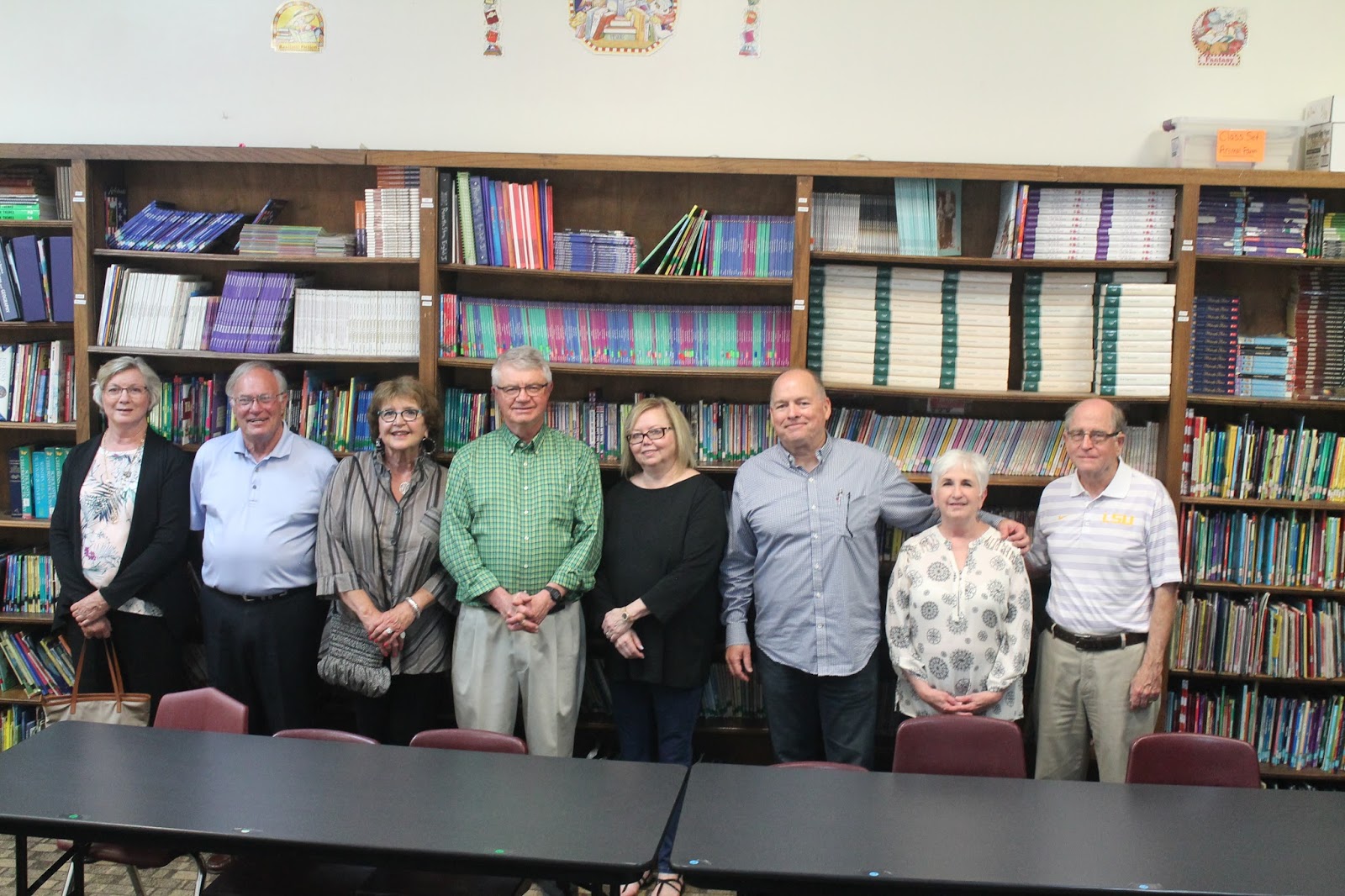
We did it!  Eight of us (with spouses) gathered at the church on May 5.

We met the principal, Chris Reid, at the entrance to the gym/cafeteria at four o'clock.  I think everyone was excited to see each other.  Bert and I checked out the new tables that fold into the walls to make for a cafeteria.  One was broken, but it looked as though they worked the same way we remembered.  The gym floor had three-point arcs painted that were not part of the game back in 1963.

The stage looked pretty much the same, although I imagine half a century of kids' heels have taken its toll on the front of the stage.  I remember students would sit on the stage to watch rainy day recess basketball games.

I wouldn't mention it, but, since Carolyn Pesce Keane insisted on visiting the storage closet, the scene of her alleged trysts with Bubba Winkler, I had to get a picture.  I remember it storing folding chairs for turning the gym into an auditorium.  Does anyone recall where those stairs went?

There was a lot of talk among the ladies about recreating their stunt of filling a bathroom stall with girls, but discretion prevailed.  They did say they were discovered by the principal, Sister Grace, but never revealed their punishment.  And there must have been punishment.  There was always punishment.

We tramped up the back stairs proud that we could all do so.  There followed several debates regarding which classes took place in which of the present day classrooms.  It seems we all have different memories of those classrooms from fifty plus years ago.

Chris briefed us on the ongoing plans to close the school (and others in the Jubilee program) and reopen as charter schools.  Bert seemed to know a good deal from the Catholic High perspective.

There's a special bond when you spend eight formative years with people.  Most of us went all the way through elementary school together.  We entered school, most without the benefit of kindergarten.  We went through various Catholic initiation rites together, had the same teachers, played under the same coaches. entered puberty together. 
Left to right:  Patricia Nowak Maffei, Al Mulrooney, Carolyn Pesce Keane, Jim Coleman, Phyllis Bernard Bethea, Bert Bailey, Judy McCarver Phillips, Jack McCormack.
And then there's this group:


These two banners, made by past graduating classes give some clue to the diversity found at the new De La Salle at Blessed Sacrament.

Next, it was time to go downstairs and see what changes have taken place in the church.  The sanctuary did not seem to me to be much changed, with the exception of the two angels on either side of the altar.

The organ/choir platform had been removed and replaced with a confessional.  The new organ was over on the side where the old confessionals had been before Penance became Reconciliation.


I sneaked into the old priests' sacristy to see if it had changed.  Less than I expected as it turns out.

Next, it was time for our dinner party at Al and Mary Mulrooney's house in Collierville.

Mary and Al had a great barbecue spread along with all the great sides you'd expect:  Cole slaw, potato salad, the works.  Add the right amount of adult beverages and we were set to go.  I wish I had taken more pictures, but I was having too much fun catching up with all these characters.


 A special shout out to my mother for being a good sport about joining us.  Not that I'm biased, but I was glad she could hear compliments like, "When she walked up I kept asking 'Which classmate is that?'"  Nobody could believe she was almost ninety-two.  Later, she told us again and again that she had such a good time.

When we graduated, I only had two siblings.  My next brother was born in August of '63, another in March of '65, and I think everyone either laughed or were struck dumb when I said that my mother was also the only pregnant chaperone at my senior prom.  My youngest sibling, a sister, was born in October of '67, as I was starting college.

 Tim Keene and Linda McCormick.


Phyllis Bernard Bethea.


Regina Coleman (IC class of '76).